I’m Not Single SVG Dog T-Shirt Design
As a designer who’s stitched hundreds of dog-themed embroidery files—from playful pups on baby onesies to bold statements on boutique aprons—I opened I M NOT SINGLE SVG DOG T SHIRT DESIGN expecting charm, but what I found was something more: a tightly composed, instantly legible graphic that lands just right between cheeky and heartfelt. It’s the kind of design that makes customers pause mid-scroll on Etsy—not because it’s flashy, but because it feels human. I tested it first on a medium-weight cotton twill tote bag for a local pet boutique’s holiday pop-up, and the result confirmed my initial impression: this isn’t just another “dog mom” cliché. It’s a well-structured embroidery file with clear hierarchy, balanced negative space, and a visual rhythm that holds up even at 3.5 inches tall.
A Design That Speaks Before You Stitch
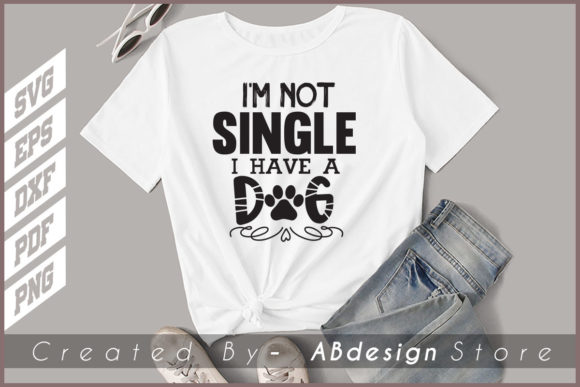
The layout is clean and centered—no cluttered borders or decorative flourishes. The phrase “I’M NOT SINGLE I HAVE A DOG” sits in a single horizontal line, using a friendly, slightly rounded sans-serif. The dog icon (a simple, stylized silhouette—likely a beagle or terrier-type) anchors the right side, scaled to complement rather than compete with the text. There’s no excessive detail: no individual fur strokes, no complex shading. That’s not a flaw—it’s smart design discipline. In machine embroidery, simplicity translates directly to stitch reliability, especially on textured fabrics like canvas or fleece. I appreciated how the letter spacing avoids tight kerning traps; each character breathes enough to prevent thread nesting during satin stitch runs.
Where This Embroidery File Shines—and Where It Needs Thought
I M NOT SINGLE SVG DOG T SHIRT DESIGN works beautifully on custom apparel where clarity and personality matter most: sweatshirt cuffs, left-chest placements on crewnecks, and front panels of relaxed-fit tees. It also translated well to a linen-cotton blend tea towel—stitched with matte cotton thread, it looked artisanal, not mass-produced. For baby embroidery? I’d recommend scaling it down to 2.75 inches max and using a lightweight cutaway stabilizer—tiny letters hold up better when density is moderate and fabric movement is controlled.
That said, caution applies in specific scenarios. On stretchy fabrics like jersey or ribbed knits, the straight-line structure demands precise hooping and a tear-away + cutaway hybrid stabilizer. On dark fabric, avoid light thread without testing contrast first—the uppercase “I” and “O” can blur if thread tension shifts. And while it’s tempting to use it on curved surfaces like baseball caps, the flat, linear composition doesn’t wrap naturally. Save it for flat or gently contoured areas: front pockets, patch backs, pillow covers, or embroidered patches meant for iron-on or sewn application.
Real Impact on Your Craft Business
For Etsy sellers and small shop owners, this embroidery file adds instant relatability to your handmade product lineup. Customers buy emotion first—this design taps into identity, humor, and loyalty all at once. When stitched cleanly, it elevates a basic tote bag from “nice” to “must-have gift.” I’ve seen similar phrases fall flat due to cramped spacing or overworked icons; here, the balance feels intentional. That builds customer trust—people assume care went into the making, which reflects well on your brand consistency and professionalism.
It’s also gift-ready. As a personalized gift for a friend’s birthday or a holiday present for a new dog parent, it reads warmly—not sarcastic, not ironic, but affectionate and grounded. That tone matters. Buyers don’t want to feel like they’re wearing a meme; they want to wear a quiet truth. And for craft fair vendors? It’s a conversation starter. I watched a customer smile, point to the dog on her own sweater, then ask about customization options—all before I mentioned pricing.
Practical Embroidery Designer Notes You Can’t Skip
Before stitching your first finished product:
- Test on scrap fabric first—especially if you’re using textured, fuzzy, or loosely woven material. What looks crisp on screen may fill unevenly under needle.
- Check thread color contrast on both light and dark backgrounds. Try black thread on oatmeal linen and cream thread on navy denim—you’ll see how legibility shifts.
- Review stitch density in your embroidery software. If the file includes dense fill stitches in the dog shape, consider simplifying or switching to a lighter fill pattern for delicate items like baby onesies.
- Confirm hoop size compatibility. While the design fits comfortably in a 4x4 hoop, verify your machine’s maximum embroidery area—and whether the file includes alternate sizes (some Graphics listings do, some don’t).
- Inspect small details at actual stitch-out scale. Tiny serifs or thin connecting lines may vanish or break apart in thread. Zoom in digitally and stitch a sample.
- Test in black-and-white mockups before listing on Etsy or your website. Color can mask weak contrast—grayscale reveals true readability.
- Use proper stabilizer for your base fabric: cutaway for knits, tear-away for stable wovens, and fusible for lightweight linens.
- Verify licensing before selling finished items or bundling this as part of a digital embroidery bundle. Since it’s listed as a Print Templates asset for scrapbooking and cut machines, confirm commercial embroidery rights separately.
This isn’t a “set it and forget it” embroidery file—but it doesn’t need to be. I M NOT SINGLE SVG DOG T SHIRT DESIGN rewards thoughtful execution. When stitched with attention to fabric, stabilizer, and thread choice, it becomes more than a graphic. It becomes a tiny, wearable affirmation—one that resonates with dog lovers, craft buyers, and anyone who values authenticity over algorithm-friendly noise. For designers building a library of reliable, emotionally intelligent design assets, this belongs in the “go-to” folder—not the “maybe later” pile.